Posts

Showing posts with the label B-Distributed Energy Generation

Clean Energy Roadmap Workshop in Austin 18-19 November

CHP Industry and Interested Stakeholders: At the upcoming Clean Energy Roadmap Workshop, the GC RAC seeks input from the CHP, waste heat recovery, and district energy industries and key stakeholders regarding market development strategies and RAC service offerings in Texas, Louisiana, and Oklahoma. A vital part of the workshop preparation is a survey of the CHP industry and interested stakeholders. Your input is needed now to help develop a successful workshop. Whether or not you plan to attend, please TAKE THE CH P SURVEY NOW Please forward the survey link to anyone you know that might have an interest in taking part. http://www.surveymonkey.com/s.aspx?sm=P59WnTuFDAM1jHWu3JZn1A_3d_3d If you are interested in attending the Workshop, come prepared to roll up your sleeves and share your ideas to help grow the CHP market in the Gulf Coast region. This event will be a major opportunity for interested stakeholders to provide strategic input to the GC RAC regarding its education and...
German Lichtblick has a DSitributed Energy Plan

Green-energy provider Lichtblick and German automaker Volkswagen are joining forces and promising to stir up the energy market with an unusual plan. Instead of relying on massive energy facilities, the average consumer may soon have a miniature power station in their basement. Chief executives of Germany's major energy suppliers usually don't have much time for their junior counterpart, Lichtblick. The Hamburg-based green-electricity provider's half a million customers may be "impressive," they say, but Lichtblick works in a niche market and is no competition for the larger companies in the industry. But things may be about to change. In the next couple of days, the relatively small company is due to reveal a new business model that could shake up the energy market quite a bit -- and not only in Germany. So, despite the fact that they currently have large power plants and considerable power over the market, things may soon turn a little less comfortable for e...

Cogeneration: a Part of the Energy Solution

In the late 1970s, John Gofman, co-inventor of plutonium, had second thoughts about his work with nuclear power over the years. He authored a book entitled Irrevy, in which he argued that the use of nuclear power for electrical production amounted to a bad tradeoff of inefficient and expensive power generation for an insoluble toxic waste problem and generations upon generations of unknown cancers and genetic defects. While the portion of domestic electricity currently produced by nuclear energy is marginal, at that time there were quite a few more nuclear power plants and nuclear energy production. A perfect storm of Three Mile Island and Chernobyl together with movies such as The China Syndrome gave impetus to an anti-nuclear movement, of which, Gofman was a pre-eminent spokesman, which changed all of that. Now, as the nation faces an energy crisis, not just of gas lines, but of all energy production, the idea of re-introducing nuclear energy with a vengeance has emerged. During the ...

Distributed Clean Energy In a Brownfield Redevelopment

BRISTOL TOWNSHIP – Pennsylvania Department of Environmental Protection Secretary John Hanger today toured The Bridge Business Center in Bristol Township, Bucks County, where $1 million in federal recovery funds are being used to install a modern energy system in a former Rohm & Haas laboratory. Secretary Hanger witnessed a milestone in the project’s development, as seven micro-turbines were lifted by crane and placed on the roof of a building at 360 George Patterson Blvd., where renovations are underway in the 50,000-square-foot, multi-tenant facility. “This is how recovery funds are making a real difference in people’s lives,” said Hanger. “In a community that has suffered from an economic downturn, we see this developer making not only a $4.5 million investment in adaptive reuse of a building on a designated brownfield site, but also in providing a clean, affordable and reliable source of energy for its tenants.” In March, Governor Edward G. Rendell announced the $1 million Penns...

Sola Ventura

Anyone know anything about Sola Ventura ? Not much on their website, but they seem to have a unique distributed cleantech business model. Sola Ventura LLC brings technology and investment opportunity together to solve clients energy needs. Onsite Green Energy Production can reduce your energy usage, lock in a lower rate for an extended period of years, and cost you nothing for installation and maintenance of any solar, wind, geothermal, and fuel cells required. Please Comment if you know more...

Feed In Tariffs - Cooperation Between Distributed Energy and Utlity Providers

This is a excerpt from the Fast Company series on Distributed Energy Generation. It reviews the emerging Distributed Energy Industry, ,and suggest feed in Tarrifs funded by a gneral utility tax. Editor In fact, wherever a little public funding has gotten the ball rolling, consumer appetite for micropower has been essentially bottomless. To see just how fast the microgrid can emerge, there's no better place to look than Germany, where the market has been blown open thanks to what's known as a feed-in tariff. If net metering is simply the right to sell your power back to the grid at retail price, a feed-in tariff adds a little sweetener on top, paid for by a surcharge on all customers' bills. In effect, feed-in tariffs offer the same financing deal to citizens at large that utilities get on any power plant they build. The tariffs have been successfully adopted in 47 countries -- but Germany is by far the global leader. The policy was introduced there back in 1999, and the in...

IBM's Energy and Utilities Group

IBM's energy and utilities group Is developing Multi-Micro Grid management Software. To make that possible, IBM is focusing on smart-grid software to manage the complexities of a system that might have 2,000 variable power inputs over 100 square miles, instead of two power plants. It's also developing cheaper photovoltaics (prices are already projected to fall by 20% to 30% this year), and Shepler has been working with the federal government to write recommendations for incentives and R&D investments. Allan Schurr, the VP of strategy and development at IBM's energy and utilities group , says simply, "Distributed energy is happening." The Rest @ Fast Company

Fast Co Explores Micro Grids

Why small-scale, local power -- the microgrid -- could be the answer to our energy crisis. And why the big utilities are fighting it with all they've got. Infographic: The Microgrid Dream House In April 2007, a helicopter landed in a backyard in Johnson Valley, California, a desert hamlet of 440 residents on the outskirts of Joshua Tree National Park. "One of the neighbors went out and asked them what they were doing just a few hundred feet from his house," Jim Harvey, a local landowner, recalls. "They said, 'We're the Los Angeles Department of Water and Power, and congratulations! You're the lucky lottery winners of a brand new power line that's going to come right through the middle of your town.' " That power line is called Green Path North -- an 85-mile-long high-voltage transmission wire from Los Angeles through public and private lands, connecting the city to potential geothermal and solar-thermal resources, with the whole shebang to be...

Distributed Power Generation Has Come of Age

I found this five year old post that proclaims they time for cogeneration has come. It is more true today than ever. -Editor The Future of Small Scale Distributed Generation Feb 27, 2004 12:00 PM, By George Zirnhelt, P.E., Power Systems Research, Inc. Even though the United States’ electric utility system delivers only 20% to 30% of potential energy to end-users, it’s still the most cost-effective means of generation available today. Distributed generation (DG) has proven to be more efficient, but its cost has been prohibitive to this point. Its supporters have been pushing to capture more of the power market for years, but until it can compete on both levels, it will have trouble. In certain situations, however, economics, reliability, and/or quality have created a circumstance where it actually makes sense for the electric power user to generate his own power. Large-scale industrial users—especially those who can also use the by-product heat—can justify the investment on economic ter...

OREG or Microgrids Two Names for Distributed Energy Resources (DER)

For those of you interested in O n site Reliable Energy Generation (OREG), moving to Renewable Energy, we have to know how grid providers see who you are and what you do. In a nut shell, they see you as an energy resource. They call you Distributed Energy Resources (DER) They call your On site energy generation a microgrid , and are fast working on ways to network all OREG resources together. This white paper , written by the Deportment of Energy in 2002 lays out the concept fairly well. - Lee Royal

AGNI Inc buys GenCell - or - Combined Heat and Power HP Buys a Fuel Cell Maker

Agni Inc has acquired Connecticut based GenCell Corporation , a Molten Carbonate Fuel Cell (MCFC) developer and manufacturer, to complement AGNI’s Proton Exchange Membrane Fuel Cells (PEMFC) and biomass / waste-to-energy technology , in its bid to expand into the North American market. GenCell’s high temperature molten carbonate fuel cell (MCFC) capabilities are well suited for integration in many AGNI renewable energy systems. AGNI’s technology converts a wide range of biomass, biogas, or fossil fuels to hydrogen, producing electricity through its PEMFC based Integrated Fuel Cell Engine power generation block. GenCell’s technology includes a cost-effective fuel cell design that will provide AGNI with more efficient, environmentally-friendly power generation. GenCell has a proprietary fuel cell stack architecture that is "designed for manufacture" to reduce fuel cell cost and improve reliability, which in turn helps make fuel cells more economical and environmentally att...

Connecticute Regualtion May hold up Fuel Cell Deployment

December 21, 2008 If fuel cells are going to be the energy technology of the future, the state may have to jettison the regulatory mindset of the past. State energy regulators may stop the largest residential construction project in the state from using a Connecticut-made fuel cell to power the building. The project in question is 360 State St., a 32-story, 500-unit apartment building under construction across from the State Street train station in New Haven. The building will contain retail space, including a fitness center and a grocery, and enclosed parking for 500 cars. At nearly 700,000 square feet, it may be the largest single residential building ever built in the state. Developer Bruce Becker also planned to make it the greenest. Becker has included 20 energy-saving technologies — a green roof, double-glazed windows and other features — and hopes to power the building with a 400-kilowatt fuel cell made by UTC Power of South Windsor. He said if it all comes together, the skyscra...

Fuel Cell Manufacturers

Acumentrics Corporation They make a 5 kw SOFC Fuel cell : Acumentrics’ 5000 Electric Power Generator Efficient: Peak efficiencies between 40-50%; up to 90% with waste heat recovery. Silent: Whisper quiet electrochemical process generates continuous electricity. Internal scrubbing: Negligible NOx and SOx output; reduced CO2 output. Solid State: Ceramic fuel cell tubes. Fuel-flexible: Compatible with natural gas, propane, biofuels, LPG, H2 \ Site flexible: Small scale package is easy to site. Grid-tie option: Allows connection to utility grid for peak shaving and net-metering. Easy operation: Rapid start and stop. Fuels can be stored onsite or delivered at residential line pressures. No external or internal pressure boosting required. Communications ready: Monitor and control using built-in Ethernet port. Altergy Altergy Systems designs and manufactures proprietary proton exchange membrane (PEM) fuel cell systems, collectively known as Altergy Freedom Power™ products . These compact, r...

CFC Solutions GMBH now MTU Onsite Energy GmbH

MTU Onsite Energy GmbH is a subsidiary business unit of MTU Friedrichshafen , a subsidiary of Tognu m AG , involved in manufacturing large diesel engines and complete propulsion systems. (thanks for the Update Bryan-see comments below) CFC Solutions became MTU Onsite Energy GmbH (Fuel Cell Systems Division) in September 2008. The company manufactures diesel engines for propulsion systems in ships, distributed power plants, heavy vehicles and rail in the power range between 35 and 9,000 kW. Since 1990, MTU has shown interest in fuel cells which resulted in the foundation of MTU CFC Solutions, now CFC Solutions. The company has been involved in the development and manufacture for molten carbonate fuel cells ("HotModule", 250kW). Since the end of 2000, MTU is also involved in PEM technology in order to develop fuel cell drive systems for off-highway applications. The focus of this work has been on propulsion systems for ships and on-board power generation. The aim is to develop...

Fuel Cell Market Analysis

The following excellent article was originally published on 18 November, 2008. By the Institue fur Kraft Fahr Zuge in Aachen, Germany. It is such an accurate and complete summary of my own research that I present it. The only difference I would have is an editors note I added near the bottom. I disagree that this technology is 4 years away from major market penetration. I believe it is imminent. -Editor The Rest Published in the Road2 hy .com . The application of Fuel Cell and Hydrogen technologies to the industrial and commercial markets takes the form of co-generation or tri -generation systems . Systems available today have total powers in the range 100kW to 2-3MW (higher power, modular, systems are possible but have not been installed) and produce electricity, heating and, sometimes, cooling. Most quoted efficiencies are 70-80% overall and 45-50% electrical, suggesting that co-generation using Fuel Cells will yield significant reductions in GHG emissions. In developed countrie...

DOE Report on a Hydrogen Economy

Image
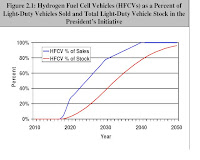
Analysis of "The Effects of a Transition to a Hyrdogen Economy on Employment in the United States" by the DOE The Energy Policy Act of 2005 required a massive Study on the effect that the transition to the Hyrdogen Economy was going to have on our overall economy. This is becasue the technolgies were already commecrailly vaiable, and would change the way we do everything from how we use power in fixed sites to how we drive. The study, The Effects of a Transition to a Hyrdogen Economy on Employment in the United States . was published in July 2008 and presented to Congress. They Examined: • Replacement effects of new goods and services • International competition • Workforce training requirements • Multiple possible fuel cycles, including usage of raw materials • Rates of market penetration of technologies • Regional variations based on geography • Specific recommendations of the study Note: do not be daunted by the dates - T Boon Pickins Media Campaign and the Gas prices, cou...

New York City Establishes MicroTurbine Sntallation Standards

March 11th, 2008 Last week, RSP Systems installed the first microturbines in New York City pursuant to a new rule for their installation and use that Mayor Bloomberg signed into law last December. RSP installed a set of Capstone C60 Microturbines at LEED Gold-certified Millenium Tower Residences in Battery Park City. According to RSP President Cory Glick, microturbines are being specified with increasing frequency in local projects for new and existing buildings, and the company has created a New York-area dealership network of electrical and mechanical contractors who can design, install, and commission Capstone microturbines. The microturbine law was drafted by a Cogeneration Task Force led by Buildings Commissioner Patricia Lancaster and Fire Commissioner Nicholas Scoppetta. Microturbines capture the heat waste generated by their turbines in producing electricity and transform it into usable energy, making them between 70 and 80 percent efficient (compared with 30 to 35 percent e...